Weight guide · Reviewed October 21, 2026
Dumpster Weight Limits: How Overage Is Billed
Every dumpster includes a set weight: 2 tons on the 10-yard up to 5 tons on the 40-yard. If the landfill scale shows more, you pay $75 per ton for the difference, billed by the exact pound, with the scale ticket attached to your invoice.
- Our own trucks & drivers
- Scale ticket on every bill
- Boards under every drop
- Overage by the exact pound
How much weight does each dumpster include?
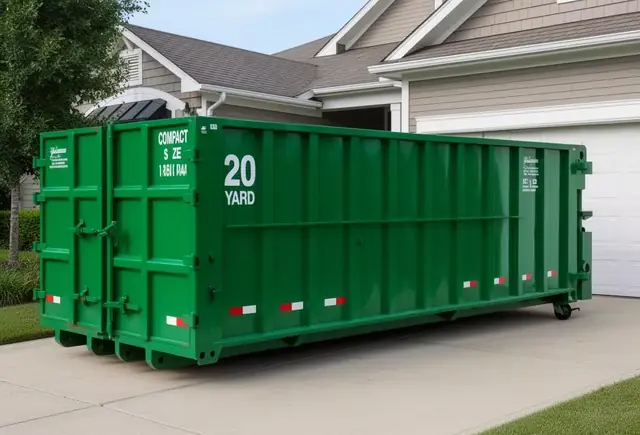
The 10-yard dumpster includes 2 tons, the 15-yard 2.5 tons, the 20-yard 3 tons, the 30-yard 4 tons and the 40-yard 5 tons. One ton is 2,000 lb. Weight over the included tons costs $75 per ton, charged by the exact pound from the landfill's certified scale ticket.
How is a dumpster weighed at the landfill?
The landfill weighs our truck twice on its certified scale: once loaded with your dumpster, and once empty after it dumps. The loaded weight is the gross. The empty weight is the tare. Gross minus tare is the net weight of your debris, and that net weight decides any overage.
- Gross: truck, container and debris together.
- Tare: truck and container after unloading.
- Net: gross minus tare, the weight of your debris.
- Over: net minus your included weight. If it is zero or less, there is no overage.
A digital copy of that ticket is attached to your final invoice, which is emailed 3 to 5 business days after pickup. The scale ticket guide walks through every line.
Example scale ticket
- Container
- 20 YD ROLL-OFF
- Gross (truck full)
- 45,460 lb
- Tare (truck empty)
- 38,660 lb
- Net debris
- 6,800 lb
- Included
- 6,000 lb (3 t)
- Over
- 800 lb
- Overage @ $75/t
- $30.00
Illustration with sample numbers. Your real ticket comes from the landfill scale and is attached to your final invoice.
How much do common materials weigh?
Loose household junk weighs about 250–300 lb per cubic yard, while broken concrete weighs about 860 lb and dirt about 929 lb. Shingles from a tear-off weigh about 731 lb per cubic yard. Heavy debris uses up your included tons long before the dumpster looks full.
| Material | lb per cubic yard | Cubic yards to reach 2 tons | Size to use |
|---|---|---|---|
| Household junk, loose | 250–300 | 13–16 | Any size |
| Yard waste, loose | 250 | 16 | Any size |
| Framing lumber | 169 | 24 | Any size |
| Carpet | 147 | 27 | Any size |
| Mixed construction debris | 417–484 | 8–10 | 20 or 30-yard, watch weight |
| Drywall | 467 | 9 | Watch weight |
| Asphalt shingles, tear-off | 731 | 5.5 | Plan by squares |
| Asphalt paving | 773 | 5.2 | 10 or 15-yard, half full |
| Broken concrete | 860 | 4.7 | 10 or 15-yard, half full |
| Dirt and sand | 929 | 4.3 | 10 or 15-yard, half full |
| Rock and gravel | 999 | 4.0 | 10 or 15-yard, half full |
Single items add up too. EPA lists a refrigerator at about 250 lb and a washer or stove at about 150 lb. A passenger tire is about 22.5 lb.
How do you estimate a roofing load?
Multiply your roof squares by the weight of one square. If your shingles weigh 80 lb per bundle and a square takes 3 bundles, one square weighs 240 lb. 25 squares × 240 lb is 6,000 lb, or 3 tons, exactly what the 20-yard includes. A second layer doubles the weight.
Use the weight printed on your own bundle wrapper, because shingles vary. Felt, nails and flashing add a little more. The roofing dumpster page has a table by squares and layers.
How do you stay under your included tons?
Keep heavy debris in its own 10 or 15-yard dumpster, filled no more than halfway. Cover the load before rain, and keep neighbors from adding to it. Pick the size by weight for roofing, drywall and tile, and by volume for furniture and household junk.
- Separate concrete and dirt: a clean, unmixed load gets clean-fill pricing.
- Break down furniture so you don't trade space for a second haul.
- Tarp the dumpster when storms are coming. Wet drywall and carpet weigh more.
- Ask before pickup if you think you're close. We can talk through your options.
Loading tips are in how to load a dumpster, and every other fee is on the cost page.
Short on time? See the overweight fees web story.
Dumpster weight limit questions
What happens if my dumpster is overweight?
An overweight dumpster still gets hauled as long as debris is level with the rim and any concrete, dirt or brick is in a 10 or 15-yard loaded halfway. The weight over your included tons shows on the final invoice at $75 per ton, billed by the exact pound. The scale ticket attached to the invoice shows where the number came from.
How do you weigh the dumpster?
The landfill weighs our truck on its certified scale with the full dumpster, then again empty after unloading. The difference between the two is the weight of your debris. That net weight, from the landfill's digital ticket, is the only number used for overage.
Do you round up to the next ton?
We charge pro-rata by the exact pound and never round up to the next half ton or ton. 300 lb over is billed as 0.15 tons, which is $11.25 at $75 per ton.
Can rain make my dumpster heavier?
Wet debris weighs more than dry debris, and the landfill scale weighs whatever is in the dumpster when it arrives. Rainwater soaked into drywall, carpet, dirt or cardboard all counts. Cover an open load with a tarp when rain is in the forecast.
How do I know before pickup if I'm over?
Use the material weights on this page to estimate your load. Count cubic yards by thinking in pickup loads (about 2.5 cubic yards each), then multiply by the weight per cubic yard. If the estimate is close to your limit, call us before pickup and we can talk through your options.
Call now · deliveries 7 AM–5 PM
Ready for a dumpster?
Tell us the project and the address. We confirm the size, the 7 days and the included tons before the truck rolls. Book by 3 PM for next-day delivery.
(432) 271-7372